Lungs

lungs album art

Florence and the Machine. (2009). Lungs. Jamaica: Island Records.

Annotation

Lungs is the first album of British indie rock band, Florence and the Machine. The band is fronted by the vocal stylings of Florence Welch and Isabella Sommers, who are accompanied by various other musicians to lay down the instrumental tracks. Florence’s sound is bluesy and intense, obviously influenced by the vocals of Amy Winehouse and PJ Harvey and telling some of the same kind of gruesome stories as one might expect to find on a Nick Cave album. Kiss with a Fist (track five) is the album’s big single and along with Cosmic Love is one of the best tracks on the album.

Genre

Indie pop, art rock, English baroque

Curriculum Ties

n/a

Reading Level/Interest Age 

14+

Challenge Issues

Florence’s music is sometimes dark and violent. Kiss with a Fist sounds like it is about domestic violence, though Florence denies it vehemently. Should parents or users object to it’s inclusion to the album in the collection a clearly worded collection development policy should offer some protection.

Reason for inclusion

I found that when I was researching this project that I mostly know nothing about modern music and am listening to the same stuff that I was listening to ten years ago. I asked my 17 year old sister what some of her favorite bands were and this one was one of the only ones I could stomach.

Speak

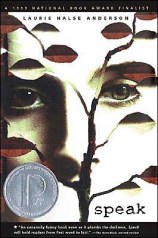
speak book cover

Anderson, L.H. (2001). Speak. Canada: MacMillian.

Reader’s Annotation

Something terrible happened at the end of the summer before Melinda started her freshman year of high school. Now her best friends in the world won’t speak to her and she can barely stand to speak herself. Will Melinda make it through the school year unscathed? Will bad memory from summer fade so she can get on with her life or will Melinda have to raise her voice and take a stand?

Plot Summary

At the end of the summer between eighth and ninth grade Melinda and her best friends went to a party that ended with Melinda calling the cops. Now the whole high school knows who she is and they all hate her. Friendless and in pain Melinda is trying to negotiate all of the regular high school traumas while negotiating her horrible secret. She stops talking to her parents, and barely makes a noise in the classroom. Art is the only subject she particularly cares about, but she’s working on a final project she thinks sucks. Everyday she is faced with the accusatory glares of her old friends at best or perhaps even worse their complete obliviousness. The safest place for Melinda is in the janitor’s closet that she has requisitioned and repurposed for her own, and yet even as Melinda starts to surface and find herself that place comes close to being violated. Walk through the halls of Merryweather High with Melinda as she uncovers the truth and lies you’re taught in school.

Critical Evaluation

Speak is an incredibly powerful novel and the main character Melinda an excellent study of a young girl in pain, suffocated by and weighed down by her own inaction. Melinda slowly stops talking because she doesn’t feel like anyone cares enough about her to believe what has happened to her. Her parents are often feuding and even more often upset with or ignoring her. Her best friends from the year before are furious with her because of the phone call to the police and she’s been labeled as a pariah by the majority of the class. It is terrifying to think that a young woman could fall through the cracks so easily, but unfortunately not unthought or unheard of. More and more frequently we hear news stories of kids being bullied and pushed toward unspeakable acts of self harm and abuse. Where are the adults who should be looking out for these kids? Melinda gets called into the principal’s office a few times, is visited by the guidance counselor, and stuck in in-class detention. No one actually reaches out to her, the one teacher who tries to make a connection is the misfit art instructor who has rejected the majority of the administration’s policies. In the end the lesson that we are left with is that only you can save yourself, which Melinda eventually does, with no little thanks to the adults in her life.

While Melinda’s story can serve as a powerful story to young people today struggling with the decision to speak out again injustice, it also demonstrates that adults are largely untrustworthy and unreliable. As a parent to a daughter this is particularly unsettling, but I think can also serve as a worthwhile reminder. Pay attention to your kids, this book seems to scream. Cultivate bonds of trust and don’t let your life get in the way of your most important job, the one you signed up for when your teen was nothing but a dream, protecting your child.

Author Information

Laurie Halse Anderson was born in 1961 in upstate New York. After her early introduction to writing  poetry, second grade, she spent a great deal of her time reading all the books in her elementary school library, “the books took me everywhere” she said. She began her career as a freelance reporter but was largely unsuccessful until she joined the critical support group, Society of Children’s Book Writers & Illustrators. Her published work varies largely, from picture books to young adult literature, to historical fiction as well as the popular American Girl Wild at Heart series, featuring Maggie and the happenings surrounding her grandmother’s veterinary office. Anderson lives in upstate New York with her second husband, their four children and a dog.

Genre

Young Adult Fiction, High School, Trauma, Abuse

Curriculum Ties

Supports reading curriculum goals for grades 9 and 10:

3.3 Analyze interactions between main and subordinate characters in a literary text (e.g., internal and external conflicts, motivations, relationships, influences) and explain the way those interactions affect the plot.

3.6 Analyze and trace an author’s development of time and sequence, including the use of complex literary devices (e.g., foreshadowing, flashbacks).

3.11 Evaluate the aesthetic qualities of style, including the impact of diction and figurative language on tone, mood, and theme, using the terminology of literary criticism.

Supports reading curriculum goals for grades 11 and 12:

3.3 Analyze the ways in which irony, tone, mood, the author’s style, and the “sound” of language achieve specific rhetorical or aesthetic purposes or both.

Booktalk Ideas

Anderson refers several times to the scabs on Melinda’s mouth. What are these scabs represent?

Why does Melinda stop talking?

Reading Level/Interest Age 

14-18

Challenge Issues

This books discusses several sensitive topics namely sexual abuse, bullying and underage drinking.

A clearly written collection development policy should offer readers and the library some protection. It is not the position of the library to police what children are reading, we trust that parents and their children have established guidelines for consumption. We support the ALA Bill of Rights and a child’s freedom to read. Forms for reconsideration are available for patron’s to fill out should they object to the material in the collection, all final decisions are made by the board after review.

Alternate suggested titles are: Tiger Eyes by Judy Blume, Stuck in Neutral by Terry Trueman

Reason for inclusion

Excellent title that handles realistic teen issues.

References

Anderson, S.H & Anderson, L.H. (2008). Laurie. Retrieved from: http://madwomanintheforest.com/laurie/.

Laurie Halse Anderson. (2010). In Contemporary Authors Online. Detroit: Gale. Retrieved from http://go.galegroup.com.libaccess.sjlibrary.org/

Why We Broke Up

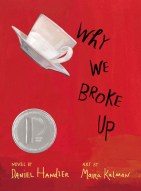
why we broke up book cover

Handler, D. & Kalman, M. (2011). Why we broke up. New York: Little, Brown Books for Young Readers. Kindle.

Reader’s Annotation

Min is an atypical high school girl, she likes old movies and is solidly grouped in her own circle of quirky friends. When she starts dating the co-captain of the basketball team, things begin to change, for her and those closest to her. Why We Broke Up is Min’s letter to her beau explaining all the reasons why, though it may have seemed so right at the time, they broke up.

Plot Summary

At a party one night Minerva, Min, Green watches Ed Slaterton and his basketball teammate drink beer in her best friend’s backyard. She feels drawn to him, though she can’t exactly explain why. Eventually she meets him for a date at her favorite second run movie house and their romance blossoms. The story is told in reverse though, so even as Min recaps in painful detail the highs and lows of their chance meeting and first date, you already know that she’s doing so to explain why she and Slaterton broke up.

The story continues with Min explaining the backstory surrounding each souvenir that she returns to him. The toy truck from the big jock party, the stolen sugar, the post card from the movie house. All are accompanied with their own heart wrenching tale and the reminder of why they broke up. 

Critical Evaluation

Min’s character is charming. She’s a punky kind of indie kid who is not into typical highschool bs. She has a passion for classic and cult films, loves coffee and seeks out the unusual. Plus, even though she’s totally oblivious to it, her supes adorbs best friend has a monster crush on her. That she falls for the dopey co-capitan of the basket-ball team seems completely out of character. All of her friends try and ask her what’s up with the new boyfriend, but she stone walls them. She sends up MAJOR warning signs, withdrawing from her old group and solidly encasing herself at the side of her jock boyfriend. Her character is so typical of a fictitious high school girl, it’s almost insulting. Another book about a girl who is so in love with her boyfriend that she totally loses sight of what makes her special is exactly what the world DOES not need. So yeah, she shows an awful lot of personal understanding in recounting the whole awful tale back to the boyfriend, apparently he’s so stupid he can’t figure it out for himself, but it doesn’t change the fact that Handler wrote a book about a girl who lost herself in love and got burned. She went against her own belief system multiple times, betrayed herself, in the long run was seriously burned by the dork who said he loved her so much. While this book burns with a heat very realistic to young romance, the story isn’t challenging to any major stereotypes. Of course the indie-kid and the jock can’t date. Of course two teenagers have a passionate love affair that they lose themselves in. Of course the jock is sexually promiscuous. It’s a fun book, with great illustrations, but there’s no piss or vinegar in it, all it does is cement the same old stereotypes and enforce the same old boring gender roles.

Author Information

David Handler was born in San Francisco in 1970. He is most well known for his series of children’s books penned under the pseudonym Lemony Snicket. He’s also written a number of picture books, one of which was adapted into a play (The Composer is Dead), and adult novels. His first novel, The Basic Eight, was published in 1999 and Why We Broke Up published in 2011 is is most recent work.

Genre

Young Adult Fiction, High School, Romance.

Curriculum Ties

Supports the California Department of Education reading curriculum for grades 9 and 10 goals:

3.6 Analyze and trace an author’s development of time and sequence, including the use of complex literary devices (e.g., foreshadowing, flashbacks).

Supports the California Department of Education reading curriculum for grades 11 and 12 goals:

2.2 Analyze the way in which clarity of meaning is affected by the patterns of organization, hierarchical structures, repetition of the main ideas, syntax, and word choice in the text.

Booktalk Ideas

This books plays a lot with stereotypes. What are some of the stereotypical ways in which the characters act? What is unexpected?

Reading Level/Interest Age 

14-18

Challenge Issues

This book touches on sensitive topics like sex and teenage drinking. This is not at all new and many of the books in this collection include such topics. The protagonist rarely engages in drinking herself, indeed she comments that she “hates beer” on more than one occasion. The sex is not described in detail, and is a by product of the love that the main character and her beau have for one another, not a byproduct of some bacchanalian drinking-spree. This book clearly supports the department of education’s reading curriculum and the library has a strong policy of supporting every user’s right to read. We do not support censorship and operate under the guidelines developed by the ALA Library Bill of Rights.

Reason for inclusion

Daniel Handler is a seminal author of many well loved stories. Including this novel adds a popular title and author to the collection.

References

Lemony Snicket. (2012). In Contemporary Authors Online. Detroit: Gale. Retrieved from http://go.galegroup.com.libaccess.sjlibrary.org/ps/i.do?id=GALE%7CH1000143627&v=2.1&u=csusj&it=r&p=LitRC&sw=w

Ender’s Game

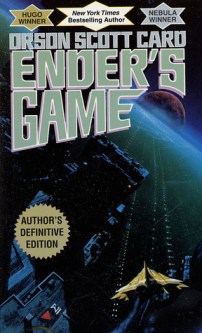
ender'sgame

Reader’s Annotation

When third son, Ender Wiggin, is chosen for elite training by the International Fleet it gets away from the torment of his evil older brother Peter, but it doesn’t guarantee his safety. Convinced that Ender is the only one who can rid the universe of Buggers, the alien race that threatens human existence, International Fleet commanders train Ender to become an elite super solider and defend the planet. Can IF control the weapon they’ve created?

Plot Summary

Ender is a third, and in a world where population is stringently controlled being a third is not a compliment. His parents had to get special permits to allow his birth, but that doesn’t give them anymore time to pay attention to him. When Ender gets chosen for training at the elite International Fleet (IF) Battle School in outer space he’s happy to get away from his evil older brother Peter, but leaving is sweet sister Valentine is harder.

The Battle School kids don’t make transition any less difficult. He’s going through grueling physical and mental training, and facing near constant, violent, torment by the likes of Bonzo de Madrid, a big bully who is outraged at Ender’s success in the classroom and in the mock battles between squads. Eventually Ender is forced to fight Bonzo, to the benefit of neither of them. Ender is terrified that he’s becoming as cruel as Peter and falls into a deep depression. Commander Graff promotes Ender to Command School to help distract him from his worries.

Though Command School is little different from Battle School, with mentally and physically exhausting demands, Ender throws himself into his work. He’s completing his trainings fast and with more ingenuity than ever before, wanting to show Commander Graff and his fellows that they can’t break him. Nearly too late Ender realizes that his been a pawn for the IF the whole time and makes a bold move to take control of his life and change the face of the universe.

Critical Evaluation

Author Information 

Orson Scott Card has written a ton of stories in the tradition of Ender’s Game. All told there are twenty stories and novels that make up the series. In addition to writing about Ender, Card also writes modern fantasy, novels inspired by the Bible, poetry, and American frontier fantasy.

He was born in Washington and grew up in California, Arizona and Utah. An active member of the LDS Church, Card did his mission in Brazil in the 70s. His most recent position is as a professor of writing and literature at Southern Virginia University. The film version of Ender’s Game is expected to release next year.

Genre

Science Fiction, War, Dystopia, Male Lead

Curriculum Ties

n/a

Booktalk Ideas

How is Ender like Peter? How is he different?

Reading Level/Interest Age 

13+

Challenge Issues

This is a violent book and that may make some users or their parents uncomfortable. We strongly encourage our users to choose books and items that are appropriate for them. As supporters of the ALA Library Bill of Rights we oppose censorship. We take requests for reconsideration very seriously and reserve the right to make the final decision after board review. Some alternate titles are: Foundation by Isaac Asimov or Spin by Robert Charles Wilson.

Reason for Inclusion

While many young women will enjoy this book I think it will also hold a strong appeal for young men and this collection needs more of that.

New Super Mario Bros. 2

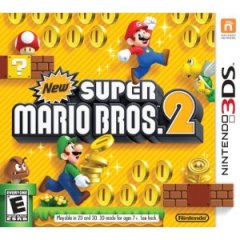
newsupermariobros2

Annotation

This is a classic Mario game. Players complete levels to advance through worlds and those who are familiar with the Mario cannon will recognize the underground world, water world and all the others that we’ve come to know over the years. Even better is that the raccoon suit is back, so Mario and Luigi can once more take flight to discover hidden worlds. Other specials include the traditional fireflower, the new gold suit, and the giant mushroom. Using your wifi network you can play two player mode and team up to defeat Bowser and rescue the Princess from the next castle. What’s more is that this game boasts a million coins and tracks your coin collection through the whole game. Can you collect them all?

Genre

handheld device, side scrolling, mario, raccoon mario, luigi

Curriculum Ties

n/a

Reading Level/Interest Age 

All ages

Challenge Issues

This game is pretty silly and fun, there isn’t any gore and honestly can’t think of any reason why a parent would object to their kid playing it, unless they didn’t want their kid to be playing video games at all, in which case they need to talk to their kid about appropriate choices at the library.

Reason for Inclusion

This is a great game anyone could enjoy. I tried to keep the game selections pretty general because I think that the ones specifically marketed to teens can be kind of violent and I didn’t want to have to play any first person shooters (they give me motion sickness).

Note: this is a handheld platform game and thereby less likely to be carried by an actual library. In the make believe world my library takes place in everyone totally has one so no worries.

Seventeen

Screen Shot 2012-12-10 at 5.00.46 PM

Seventeen Magazine, (2012). New York: Hearst Corporation. Retrieved from: http://www.seventeen.com/

Annotation

Seventeen magazine was the first magazine published in the US marketed exclusively to teen girls. It was first published in 1944 and currently has over 2 million subscribers. Seventeen‘s major focus is on fashion, beauty, celebrity culture, and romance. The magazine also features a “traumarama” section where readers share embarassing stories, and of course a ton of different kind of quizzes.

Critical Evaluation

I really struggled with whether or not to include Seventeen because in my ideal world girls are reading magazines that are more about how awesome they are and less about how to impress guys and get the perfect eye makeup. Then I tried to put on my objective cap and remembered that even I liked to read Seventeen when I was a teenager, and it’s not like Sassy exists anymore, and I thought including the British or Australian girl positive magazines might be too much of a stretch, so Seventeen it is. I’m still not crazy about the hyper focus on what guys think and getting your look just right, but the quizzes are just as mindless and fun as they’ve ever been.

Reading Level/Interest Age 

15+

Challenge Issues

Some parents may object to their teens reading Seventeen. The magazine is pretty subtle in it’s indoctrination of young girls into the cult of femininity and womanhood, but maybe that is what parents are objecting to. As with all the items in the collection we urge our users to make the right choices for themselves. The library does not monitor its user’s reading habits, nor does it support censorship. We take reconsideration requests very seriously and reserve the right to make final decisions after review by the board.

Reason for Inclusion

This is a wildly popular magazine that will appeal to many of our readers.

References

eCirc for Consumer Magazines. (2012). Audit Bureau of Circulations. Retrieved from: http://abcas3.auditedmedia.com/ecirc/magtitlesearch.asp

Moorehouse, E. (2007). History. Everything Teen Magazine. Retrieved from: http://iml.jou.ufl.edu/projects/fall07/Moorhouse/index.html

Ghost World

ghostworld


Clowes, D. (1993). Seattle, WA; Fantagraphics Books. Print.

Reader’s Annotation

Ghost World is the story of Enid and Becky,  two recent high school graduates who have been friends forever and spend their time bumming around town, drinking coffee and harassing their mutual friend Josh, who they might both have a crush on. The girls soon find that growing up sometimes means growing apart, as the friendship that once seemed so solid and permanent begins to crumble.

Plot Summary

Enid and Becky are two super smart and witty girls who like to do the kinds of things that bored teenagers waiting for something to happen do: they try on wigs, drink endless cups of coffee at their local cafe, people watch, look for awesome stuff at garage sales and harass the nice clerk at the convenience store, Josh. They’ve been friends forever and intend on keeping it that way, they’re going to get a place together when Enid goes to college.

The girls are growing apart though, and it’s a painful transition. Both of the friends are attracted to Josh, and there is some disagreement over who should “get” him. Enid is really confused about her sexuality, and doesn’t even really know if she wants to be with Josh or if she just wants him because Becky wants him. Or if maybe, actually, if she wants Becky.

In a coming of age story that ends painfully and realistically, Ghost World is a must read for anyone who loves comics, has ever been a teenage girl, or suffered a particularly painful loss of friendship.

Critical Evaluation

This is another one of those books that I read for the first time when I was a young adult and am rereading for the project. It was SO PAINFUL. I felt like all I did was cringe through the whole novel and then I felt old. I guess I need to read more things for YAs in their late teens and early twenties because I have seldom felt as uncomfortable reading a book as I did reading Ghost World. I think part of it was that I strongly identified with Enid when I was a young woman (was there a smart, cute, kinda punky, nerd girl who didn’t identify with Enid in the 90s?), so rereading Ghost World was a serious walk down memory lane. Here’s the thing about Clowes, he managed to perfectly capture, at least in my case, what it is like to 18 or 20 or whatever, and have only a vague idea of what the future holds. He totally gets it. Enid knows just enough about herself to know that she’s not going to stick around in her boring ass town forever, but doesn’t quite trust herself enough yet be direct in her approach with her friend Becky or her would be lover Josh. She’s everywhere at once and wants everything and nothing and none of it makes any sense. Clowes captures that feeling perfectly and I think anyone who has ever been there will totally be able to relate to that. So long as they can get around all the swearing.

Author Information

Daniel Clowes was born in Chicago in 1961. He got a BFA from the Pratt Institute in Brooklyn in 1984 and published his first work just a year later in Cracked magazine. He’s probably most well known for the comic Eightball which he wrote in 1988 and where the majority of his later characters first appeared. Eightball ran until 2004 and won many Eisner, Harvey, and Ignatz awards. His well known titles also include Wilson and Mister Wonderful. Most recently his work has been presented at the Oakland Museum of California.

Genre

comic, coming of age, strong female lead

Curriculum Ties

n/a

Booktalk Ideas

Do you think Enid and Becky hate everything? Why or why not?

Reading Level/Interest Age 

17+

Challenge Issues

There are a lot of swears in this book, it is undeniable. There’s also bunch of sexy talk and this comic is definitely intended for older young adults. Alternate graphic novels that would appeal to young YA readers are Y the Last Man, The Pride of Baghdad, and Persepolis. 

Reason for Inclusion

This a contemporary coming of age story. It will appeal to readers who prefer comics and also those who just like good stories.

Mad Magazine

MAD-Magazine-Sing-Along-with-MAD

DC Entertainment (2012). Mad Magazine. Retrieved from: http://www.madmagazine.com/

Annotation

MAD magazine is a humor magazine published by DC Entertainment, a company probably best known for it’s comic books. MAD magazine runs comics, tv and movie spoofs, and specializes in satirical humor on public figures, pop culture, life and politics.

Critical Evaluation

I really don’t have much of an opinion of MAD. The mascot, Alfred E. Nueman, has always kind of given me the creeps and I never really got into it as a kid. It’s another one of those situations wherein I know that it is supposed to be funny but I don’t find it particularly amusing. There’s a ;ot of toilet humor, red neck jokes and other kinds of comedy that don’t really appeal to me. That’s okay though, this collection is supposed to be more about the needs of my users and less about my favorite forms of media.

Genre

humor

Curriculum Ties

n/a

Reading Level/Interest Age 

13+

Challenge Issues

Like I mentioned above MAD uses a lot of toilet humor an bawdy language. Some parents will probably find it offensive. As with all of our titles we encourage each user to choose the medium and mode that is best for him or her. We follow the ALA Library Bill of Rights and defend censorship at all costs. All reconsideration requests are taken very seriously and the library reserves the right to make a final judgement after board review.

Reason for Inclusion

This a popular item at the library where I work. I included it to help the collection be more attractive to young men.

Alternative Press Magazine

200px-AltPressMagCover

Alternative Press. (2012). Alternative Press Magazine. Cleveland, Ohio. Retrieved from: http://www.altpress.com/magazine

Annotation

AltPress is a music magazine that showcases alternative rock music. The magazine contains interviews, tour dates, song charts, photos and information on new releases. Some of the featured bands in the past year include Green Day, Breathe Carolina, and Paramore. The magazine releases special issues on large events like Van’s Warped Tour and the Airwalk AP tour.

Critical Evaluation

This is a fine magazine for anyone interested in contemporary alternative rock. Of course, my word has to be taken with a grain of salt because I don’t listen to contemporary alternative rock and have barely heard of any of the bands featured in the magazine, but I think if I ever were to do such a thing, and cared to look at a magazine featuring my favorite bands, and was 15, this would be the magazine a that I would choose.

Genre

music

Curriculum Ties

n/a

Reading Level/Interest Age 

14+

Challenge Issues

Parents may find some of the bands featured, and their pictures, unsavory. This magazine often features folks with lots of tattoos and piercings. The library takes no position on tattoos and piercings and strongly urges parents and teens to have an understanding on what is appropriate reading material. The library supports the ALA Library Bill of Rights and as such does not condone censorship. That said, forms for reconsideration are available, and the library reserves the right to make the final decision after board review.

Reason for Inclusion

My library is sadly lacking in material that appeals to young men. I did some research to see what the dudes were reading and this magazine was one of the results.

My Sister’s Keeper

Picoult, J. (2004). My sister’s keeper. New York: Washington Square Press. Audiobook.

Reader’s Annotation

Anna is suing her parents for medical emancipation. A so-called designer baby, her embryo was specifically selected because it was a genetic match to her sister, Kate, who was diagnosed with acute promyelocytic leukemia at age three. What happens when one sister refuses to be a donor for another? Will Kate survive long enough to find out?

Plot Summary

Anna Fitzgerald is not sick, but she has been hospitalized repeatedly from a young age. Her older sister, Kate, has a rare and aggressive form of leukemia and Anna is a perfect genetic match, a personal blood and marrow farm for her terminally ill sister. When Anna is 13 and Kate needs one more donation, a kidney, Ana puts her foot down. She hires the ornery attorney  Campbell Alexander to represent her case for medical emancipation, much to the shock of both her parents when they are served with papers in Kate’s hospital room.

As the family struggles to survive the book reads from the perspective of all the major characters: their mother, Sara Fitzgerald, tells the story of Kate’s cancer from diagnosis to present day. Jesse Fitzgerald is the eldest child of Sara and Brian, and his story is that of the forgotten son, misfit and trouble maker he struggles to find his place in the family that gave up on him in favor of Kate so long ago no one can really remember how it happened. Brian Fitzgerald is father to the three children and husband to Sara, his narrative takes place in the present day as he struggles to protect his children and keep his marriage whole. Julia Romano is the beautiful court appointed guardian ad litem and spurned high school lover of Campbell Alexander, the attorney with the mysterious service dog who keeps everyone at arms length.

My Sister’s Keeper is a beautiful coming of age story about a family discovering what it means to act autonomously in the face of death and betrayal.

Critical Evaluation

Normally Jodi Picoult isn’t the kind of author that I’m drawn to. I know that her books are high circulating and that she’s a best seller and that everyone loves her, but I generally don’t have any patience for this kind of story, what with its love and feelings (that was supposed to be funny). I read My Sister’s Keeper specifically to include it in this project and was pleasantly surprised by the contents. This is not a shallow-feel-good-family story. Picoult gives each character depth and personality, and as readers we become intimate with struggles and pains of all the players.

Jesse was one of my favorite characters. In the story Jesse and both of his parents say repeatedly that he’s the one everyone has given up on. This blew my mind. Is this a real thing? Your one kid gets cancer and you let the other one live above the garage and brew moonshine? The thing is that Jesse tries so hard to be nonchalant about his parents disappointment, or I guess non-responsiveness, but he desperately wants to be a member of the family that matters: he asks Kate’s doctor, with tears in his eyes, if he could be a donor for her when her death seems all but imminent; he sets these outrageous fires which his dad, capitan of the fire department, has to come to put out. If anyone could ever wave a flag that said “here I am, notice me!” this kid is doing it.

Author Information

Jodi Picoult was born and raised in Long Island, New York. She began writing a very young age, 5, and her first story was called The Lobster Which Misunderstood. She went on to study creative writing at Princeton and is the author of eighteen best-selling novels. Some her first work was published by 17 Magazine while she was still a student. Before becoming a full time novelist she held several other positions in writing and education: technical writer for a brokerage firm, copywriter at an ad agency, editor at a textbook publisher, and teaching 8th grade English. Eventually she returned to school and obtained a Master’s in Education.

She’s won a ton of awards for her work, an Alex Award from the Young Adult Library Services Association and a New England Bookseller Award for Fiction, just to name a couple. In addition to her 18 novels she also penned 5 issues of Wonder Woman for DC Comics and he work has been published in 35 countries, and several novels were produced as television movies, and of course My Sister’s Keeper her first big screen movie. In short, Picoult is a well loved American author who’s work appeals to all kinds of readers.

Genre

Young Adult Fiction, Cancer, Families, Adult Fiction

Curriculum Ties

n/a

Booktalk Ideas

Do think Brian and Sara have a happy marriage?

What is Jesse trying to accomplish with his fires?

Reading Level/Interest Age 

14+

Challenge Issues

This novel is pretty clean, though it is obviously about cancer and death, it’s hard to imagine what a parent/patron would object to. As with all the items in this collection a strong collection development policy, along side our clear support of every reader’s right to read and protection from censorship, backed by the ALAs Library Bill of Rights, should offer some protection. We trust that parents and their children have agreed amongst themselves what is appropriate reading material.

Reason for inclusion

This is a touching coming of age novel written for adults that will appeal to YA readers, included as a crossover novel.

References

Picoult, J. (2012). About Jodi Picoult. Retrieved from: http://www.jodipicoult.com/