World Book Student

Screen Shot 2012-12-10 at 8.43.53 AM

World Book Inc, (2011). World Book Student. Chicago, Illinois. Retrieved from: http://0-www.worldbookonline.com.catalog.sjlibrary.org/student/home

Annotation

World Book has been publishing encyclopedias and reference materials for over 90 years. They boast the most inclusive online content to serve the information needs of young people and educators.

Critical Evaluation

The World Book Student homepage has a lot of information on it. After you login through your library’s website you can do a quick search for the information that you’re looking for with the basic search toolbar. You can also browse content alphabetically or by subject, as well as by way of the dictionary and atlas. The rest of the homepage is divide into topics of high interest. There are popular videos, research tools complete with citation builders, a biography center, quizzes, popular articles and much much more. I prefer to use databases that are less busy, but I think that the display allows young people to quickly access the material that they are looking for.

Curriculum Ties

Grade 9 and 10 reading comprehension curriculum:

2.2 Prepare a bibliography of reference materials for a report using a variety of consumer, workplace, and public documents.

2.3 Generate relevant questions about readings on issues that can be researched.

2.4 Synthesize the content from several sources or works by a single author dealing with a single issue; paraphrase the ideas and connect them to other sources and related topics to demonstrate comprehension.

Grade 11 and 12 reading comprehension curriculum:

2.1 Analyze both the features and the rhetorical devices of different types of public docu-ments (e.g., policy statements, speeches, debates, platforms) and the way in which authors use those features and devices.

Reading Level/Interest Age 

All ages

Reason for inclusion

Database for scholastic research.

Opposing Viewpoints in Context

opposingviewpoints

Gale, (2012).Opposing Viewpoints in Context. Ontario, Canada: Gale. Retrieved from: http://www.gale.cengage.com/InContext/viewpoints.htm

Annotation

Opposing Viewpoints in Context is a database tailored to the special research needs of young adults. Covering society’s hottest topics Opposing Viewpoints is your go to source for information for all your homework needs: research papers, expository essays, preparation for current event discussions and debates, and more.  Opposing Viewpoints boasts over

14,000 pro/con essays, 5,000 topic overviews… 300 primary source documents, 300 biographies of social activists and reformers… 775 court-case overviews, 5 million periodicals… 6000 statistical tables… 70,000 images… thousands of podcasts… and national and state curriculum standards

Critical Evaluation

Opposing Viewpoints is laid out nicely and easy to navigate. Once you log in through your library’s portal you can use the basic search option to do a quick search on the topic that you’re interested in. There are also options to browse popular issues, view data maps, and search by resource (viewpoints, academic journals, primary sources, statistics, image, video, audio, news, magazines, reference website, etc). Within the advanced search options users can use boolean search terms, narrow results by peer reviewed and full text, publication date, document type and so on. The database has clean lines and is easy to navigate. There are no extraneous buttons or search options hanging about to confuse anyone. It is an excellent choice for beginning researchers, or those without a lot of experience using databases.

Curriculum Ties

Supports grade 9 and 10 reading comprehension curriculum:

2.2 Prepare a bibliography of reference materials for a report using a variety of consumer, workplace, and public documents.

2.5 Extend ideas presented in primary or secondary sources through original analysis, evaluation, and elaboration.

Supports grade 11 and 12 reading comprehension curriculum:

2.1 Analyze both the features and the rhetorical devices of different types of public docu-ments (e.g., policy statements, speeches, debates, platforms) and the way in which authors use those features and devices.

2.3 Verify and clarify facts presented in other types of expository texts by using a variety of consumer, workplace, and public documents.

Reading Level/Interest Age 

13+

Reason for inclusion

Important database for student research.

Science in Context

Gale, (2012). Science in Context. Ontario: Canada. Retrieved from: http://www.gale.cengage.com/InContext/science.htm

Annotation

Another of the In Context databases, Science in Context has been designed specifically for the needs of young academics. SIC content is derived from reference sources such as: Gale Encyclopedia of ScienceChemical ElementsScience in Dispute and the Macmillan Science Library. Additionally the database contains over 22,000 topic overviews, 7,000 biographies, 1.5 million periodical articles, 16,000 images and videos, over 170 detailed experiments, 8,100 biographies, and two dictionaries.

Much like the other Gale databases in the collection SIC is easy to navigate. You can search by keyword or topic, narrow results by year, search by person (by or about), narrow results by peer reviewed and full text, publication date, document type and so on. Gale databases are easy to learn and operate and ideal for students who may not have the time or inclination to spend several hours learning how to navigate several different kinds of databases.

Curriculum Ties

Science, Chemistry, Biology, Anatomy, etc.

Reading Level/Interest Age 

12+

Reason for inclusion

Academic database for science based research.

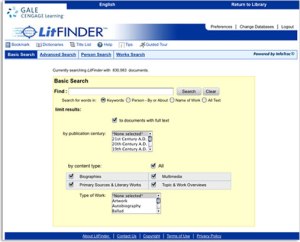
LitFinder

LitFinder

Gale, (2012). LitFinder. Ontario, Canada: Gale. Retrieved from: http://gdc.gale.com/gale-literature-collections/litfinder/

Annotation

LitFinder is Gale’s primary collection of literary works. The collection includes 140,000 full-text poems, 800,000 poem citations and excerpts, 7,100 full-text short stories and novels, 3,800 full-text essays, 2,000 full-text speeches and 1,700 full-text plays. It also includes biographies, work summaries, photographs and a glossary. It is specially suited to the needs of young adult researchers and like all Gale products boasts a simple layout and search process.

Critical Evaluation

I like Gale databases and this one is no exception. The lines are smooth and uncluttered and it is easy to specify your needs with the simple and advanced search methods. Unlike some of the other databases in this collection, there’s no fuss or glamor on the homepage of the LitFinder database. You can search by keyword, person (about or authored by), or all-text. Searches can be narrowed by decade, content type (biography, primary source & literary works, multimedia, and topic & work overview), as well as by type of work. Gale’s easy to learn and use interfaces lend themselves to straight forward searches, but also allowed for more sophisticated methods such as using boolean search terms.

Curriculum Ties

Grades 9 and 10 listening and speaking strategies curriculum:

1.10 Analyze historically significant speeches (e.g., Abraham Lincoln’s “Gettysburg Address,” Martin Luther King, Jr.’s “I Have a Dream”) to find the rhetorical devices and features that make them memorable.

Grades 11 and 12 reading comprehension curriculum:

2.3 Verify and clarify facts presented in other types of expository texts by using a variety of consumer, workplace, and public documents.

Reading Level/Interest Age 

12+

Reason for inclusion

Academic research database.

Temptation (Secret Diaries #1)

temptation


Harrell, J. (1994). Temptation. New York: Scholastic. Print.

Only the first book from this series is included in the collection.

Reader’s Annotation

Joanna is new in town, deciding to move in with her father in the middle of the school year, and she doesn’t know anyone in her high school. She notices Penn and his group right away though, and knows that she’s got to be part of their group, no matter what it takes.

Plot Summary

Joanna is attracted to Penn from the very first moment she lays eyes on him, but she can’t figure out how to get to know him better. He and his group of friends seem so close and mysterious, it’s hard to break in. After Penn invites her to coffee with the gang Joanna feels even less sure of her ability to assimilate into the group, they all seem to be grieving over the disappearance of their friend Laurie and she while she is curious about the missing girl she’d much rather focus her attention on Penn.

As Joanna and Penn become more intimate warning signs begin to flare up. Super smart Casey is going out of his way to be extra annoying, while quite and sensitive Stephen starts have angry outbursts that frighten Joanna. One night she runs across Stephen and Tessa watching their car as it burns up. Joanna doesn’t know what to make of all this, and what she suspects is too terrible to take seriously. Surely this group of close knit friends couldn’t be responsible for the disappearance of one of their own, could they? Is Joanna in danger too?

Critical Evaluation

This is another one of those purely campy novels. It’s terrible, really. The story line is crystal clear, and the Joanna, the lead, has as much depth as a kiddie-pool, her main concern is getting (and holding) the attention of Penn, who drives his red Corvette too fast all over town. I have to admit that when I first read this book 15 or 16 years ago I was totally ga-ga over Penn too, so I guess I can’t fault Joanna that.

Author Information

There’s not a lot of information available about Janice Harrell out there, she isn’t a current author, has no Goodreads or Amazon page and no one has written anything about her in any of the literary review databases. It looks like she published a number of horror and suspense books in the mid-80s to the mid-90s and then completely fell off the radar.

Genre

YA Fic, horror, suspense

Curriculum Ties

n/a

Booktalk Ideas

What would you do in Joanna’s shoes? Would you keep the groups secret or go to the police?

Reading Level/Interest Age 

14+

Challenge Issues

This is a suspenseful horror novel and some parents/patrons may object to some of the material contained within. This library encourages ever reader’s right to read, and strongly urges parents and teens to discuss and decide what is right for them to read. We do not support censorship, in accordance with the ALA Library Bill of Rights.

Reason for Inclusion

I really liked this novel when I was a teenager and included it for that reason alone.

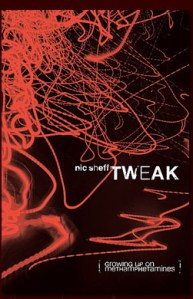
Tweak

tweak

Sheff, N. (2008). Tweak: Growing up on methanphetamines. New York: Atheneum Books for Young Readers. Print.

Reader’s Annotation

Nic Sheff has it all: a supportive family life, acceptance into a top tier university, is a published author before he even graduates high school. After meth though, nothing is the same for Nic, all he thinks about is his next score. Read along as Nic struggles to get clean and beat meth once and for all.

Plot Summary

After 18 months sober Nic skips out on his job and apartment in LA and drives to San Francisco. Almost immediately he meets up with a girl, Lauren, he hung around with briefly in high school. She’s got 4 months sober and together the two of them score some meth and delve deep into the depths of depravity. Nic has got about three thousand dollars to his name and he knows that it won’t last long when he’s supporting the meth habits of three people along with a little heroin abuse on the side for good measure. The only reasonable thing to do, Nic reasons, is to start selling meth himself, and thus Nic enters into a plan with his dealer, Gack, to buy and distribute meth.

It isn’t too long before Nic hits rock bottom and manages to drag himself back to LA, where his sponsor, Spencer, is waiting to help him get back on his feet. As Nic begins to work his way through the twelve steps with Spenser he feels confident in his ability to stay clean, but still longs for a deep and meaningful connection with someone. Enter Zelda, the older woman who Nic was having an affair with previous to his relapse. As Nic and Zelda become more and more involved Nic finds himself falling into old destructive patterns, but he is so in love that he doesn’t care. What will become of Nic once he discovers that Zelda is using again? Will Nic ever find the courage to stay sober in the face of all of his pain?

Critical Evaluation

This book has received a lot of criticism, especially in the face of Nic’s dad’s book Beautiful Boy, which tells David Sheff’s version of the same story. Critics complain that Tweak is told from the perspective of a privileged, whiny, white kid and that his obsession with fame and tendency to name drop is a display of immaturity. They are all correct. Nic Sheff was 22 when he wrote this book and it is apparent in the tone of memoir. It’s good though, he doesn’t hold anything back, not so far as it is obvious anyhow, and his story is easily read (though perhaps not for the squeamish). Part of what is good about this novel is how young Nic is, how the language that he uses allows the book to be accessible for the population that it will most benefit: young adults.

Author Information

Nic Sheff was born in 1982 and raised in Marin County California. His first published material appeared in Newsweek in 1999 and was about being raised as a kid who had to split his time between two families, as per his parent’s divorce agreement.

Nic states that he began experimenting with drugs and alcohol when he was around 12 years old and did meth for the first time around the time he was 17, and did his first stint in rehab at 19. Since Tweak was published he has struggled with relapse several times, but has a current sober date of November 2008. His most current book We All Fall Down picks up where Tweak  left off and claims to tell a more mature tale of sobriety.

Genre

Non-Fiction, Drug Memoir, Methanphetamine

Curriculum Ties

drugs(?)

Booktalk Ideas

Nic says several times that he uses to escape his bad feelings. Where do you think these feelings originated from?

Reading Level/Interest Age

17+

Challenge Issues

This book is chalk full of sex, bad language and drug use. It is certain to offend some readers or their parents. As with all of our books we encourage readers to choose what is right for them. We support the ALA Library Bill of Rights and avoid censorship of materials. We will reconsider books, but reserve the right to make final decision after review by the board. Alternate titles that handle the same subject are: Blackout Girl: Growing Up and Drying Out in America by Jennifer Storm and Come Back: A Mother and Daughter’s Journey Through Hell and Back by Claire Fontaine and Mia Fontaine.

Reason for Inclusion

Opens up an important discussion of drug abuse/depression. Realistic portrayal of the life of an addict.

Clockwork Angel

clockwork angel

Clarke, C. (2010). Clockwork angel. New York: Margaret K. McElderry Books. Print.

Reader’s Annotation

When Tessa Gray sets out across the Atlantic to join her brother in London she expects a grand adventure and a new life. What she ends up discovering is a world rife with demons, vampires and other creatures that go bump in the night. Under the protection and guidance of the Shadow Hunters, an underground organization dedicated to fighting the monsters, Tess must work against the clock to save her brother and protect all she knows and loves.

Plot Summary

Tessa Gray is all alone in the world: the aunt who raised her has died and her brother is overseas trying to make his fortune. When he sends for her she is overjoyed at the thought of being reunited with him. Only she is kidnapped by the evil Dark Sisters and forced to do acts of magic that she barely understands.

After a daring rescue by the mysterious Shadow Hunters, Tessa takes up residence at their London Institute: headquarters and training grounds for the group. Tessa agrees to use her power to help the Shadow Hunters in exchange for their help finding her brother. That is if she can avoid the distraction of the two devilishly handsome Shadow Hunters Will and James, who both have an undeniable allure and their own secrets.

She soon finds that she may have to choose between the task she set out to complete and the promises she’s made. Unsure of who to trust and which are the right decisions Tessa must look within herself for the answers the strength to move on.

Critical Evaluation

Some of this novel is a little ridiculous. The teen boys, James and Will, take themselves a little too seriously and buy into their own hype a little too much for my taste. Will knows how dashingly handsome and mysterious he is and totally plays into it. It’s obnoxious. The efforts that James goes to to hide his illness is ridiculous, in not wanting to make a big deal about it or have people pass judgement on him because of it, he manages to come off and a whiny idiot and indeed does exactly what he’s trying to avoid. Overall though? It’s a fun novel if you can look past the self involved characters (and really, what teenager isn’t self involved) and just enjoy the novel for what it is: a mechanized novel that takes place in Victorian England (am I the only one who thinks that the inclusion of cogs = steam punk is hilarious?).

Author Information

Cassandra Clare was born overseas, in Tehran, Iran. She spent her formative years travelling the world with her family, living in locations all over Europe before her tenth birthday. She published her first work in 2004, a short story called The Girl’s Guide to Defeating the Dark Lord  which is included in a Baen anthology of humor fantasy. City of Bones was her first novel, and exists in the same world, though present day, of the Clockwork Angles world. She’s published 18 books, five of which are co-authored with Holly Black. Most recently she published the sequel to Clockwork Angels, titled Clockwork Prince and Yen Press is due to release a manga version of Infernal Devices this winter.

Genre

Steam Punk, YA Fiction

Curriculum Ties

n/a

Booktalk Ideas

In Tessa’s position would you have gone with the Dark Sisters?

Reading Level/Interest Age 

15+

Challenge Issues

There is violence and some smooching in this novel and some patrons may feel uncomfortable with that. As ever the library urges that readers and their parents choose for themselves what is appropriate for them to read. Should you wish to challenge a book forms for reconsideration are available, though the library reserves the right to make a final decision after review by the board. Alternate titles to consider in lieu of this novel are Once a Witch by Carolyn MacCullough and Hush, Hush by Becca Fitzpatrick.

Reason for Inclusion

A fun read that will appeal to those who enjoy steampunk culture.

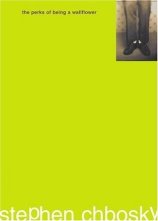
The Perks of Being a Wallflower

Book Cover

Chbosky, S. (1999). The perks of being a wallflower. New York: Gallery Books. Print.

Reader’s Annotation

Depressed high school freshman Charlie narrates a series of letters to a friend he’s never met. His letters reflect the confusing world around him as he negotiates this strange new world where people die, get high, have sex and experience all kinds of new feelings and ordeals.

Plot Summary

Charlie is depressed. His best friend committed suicide over summer and he doesn’t feel especially close to his parents or his older sister. He had an aunt Helen once, whom he adored and trusted, but she’s dead too. Things start to get better for Charlie when he befriends Sam and Patrick, an older step-sister and brother duo that take Charlie under their wing.

Charlie is still a teenager though, and still confused about his place in the world. Charlie has romantic feelings for Sam, despite the fact that they both agree that she’s too old for him. Even so he struggles with his affection, especially after Sam begins dating Craig, a “hunky” boy her own age. Charlie eventually begins dating a girl his own age, Mary Elizabeth, but that relationship ends when his preference for Sam becomes undeniably clear. Additionally Charlie appears to be suffering from something more than a mild depression as result from his friend’s death. This is especially telling as his favorite song is “Asleep” by The Smiths, a song rife with allusions of death and suicide, as well as his return to Catcher in the Rye, a book that is narrated by another troubled young man. He also confesses to memory loss and hallucinations, definite signs of more troubling mental problems.

There are several other important relationships explored in Charlie’s narrative. Sam’s stepbrother Patrick is in a relationship with Brad, high school football quarterback, who is still in the closet. After a series of close calls, the couple is caught in the act and a series of traumatizing events follow, ending with a gang of jocks attacking Patrick and Charlie rushing to his defense. Charlie’s English teacher, who allows Charlie to call him Bill outside of class, takes a special interest in Charlie and encourages him to take participate in the high school experience.

As the book comes to a close Charlie confront his desire for Sam and begins to resolve his emotional problems.

Critical Evaluation

Perks is a really great novel. Chbosky does an excellent job of creating a character that I believe many teens, and adults for that matter, can relate to. I read it for the first time when I was twenty and now eleven years later I appreciate it on a whole other level. As Charlie stumbled and tripped his way through his first year of high school I sometimes cringed at his innocence and other times railed at the way he had been manipulated and abused by other characters in the novel. Still other times I wanted to shake him for being so self-centered, in particular the truth or dare scene when he kisses Sam– that is such a crappy and passive aggressive way to end a relationship, way to be a dick, Charlie. Overwhelmingly though, my impression of Charlie was someone who really needed a hug and someone to help him through some really rough times. The question I keep asking myself, and it seems a common thread in this kind of novel, is where the hell were his parents? Why didn’t they know something was wrong, that he was suffering so? As a mom I have a really hard time understanding how you just wouldn’t know something was wrong with your child and in Perks (Speak too, for that matter), I just don’t get why Charlie folks were so checked out.

Author Information

Stephen Chbosky was born in Pittsburg, Pennsylvania in 1970. He achieved a BFA from USC in 1992 and wrote, acted and directed his first piece Four Corners of Nowhere in 1995. MTV Books published Perks in 1999 and it quickly become their best selling novel. Chbosky has written a number of other screen plays and movies, including the 2005 movie adaptation of Rent and most recently has directed the movie version of Perks. 

Genre

Young Adult Fiction, High School, Coming of Age.

Curriculum Ties

n/a

Booktalk Ideas

Charlie reads Catcher in the Rye several times in the course of this novel. How does his character compare to Holden Caulfield?

Reading Level/Interest Age 

14 and up

Challenge Issues

Sex, drugs, suicide, homosexuality, violence, abortion.

Reason for inclusion

Modern great American novel. Deals with very real issues that high schoolers face on the day to day.

References

Beisch, A. (2001). Interview with Stephen Chbosky, the author of the perks of being a wallflower. LA Youth. Retrieved from: http://www.layouth.com/interview-with-stephen-chbosky-author-of-the-perks-of-being-a-wallflower/

Bing, J. (2000). ‘Perks’ guy in pics; Nerve wracking up deals. Variety. Retrieved from: http://www.variety.com/article/VR1117787257?refCatId=1007

Stax. (2005). 10 questions: Stephen Chbosky. ING. Retrieved from: http://www.ign.com/articles/2005/12/01/10-questions-stephen-chbosky

Stephen Chbosky. (2006). In Contemporary Authors Online. Detroit: Gale. Retrieved from http://go.galegroup.com.libaccess.sjlibrary.org/ps/i.do?id=GALE%7CH1000161510&v=2.1&u=csusj&it=r&p=LitRC&sw=w

Veronica Mars

Image

Veronica Mars: The Complete Series. Dir. John T. Kretchmer. Writer Rob Thomas. Perf. Kristen Bell, Percy Daggs III, Jason Dohring. CW, 2004. Netflix.

Reader’s Annotation

High school sleuth, Veronica Mars, assists her private detective father (recently demoted town sheriff), solving mysteries for the community of their small town, but she’s also got a few mysteries of her own to solve. How did her best friend die? And why has her mother disappeared too?

Plot Summary

Veronica Mars is a classic high school teen; she’s got a hot boyfriend, is on the cheerleading squad and has the love of two amazing parents. That is until her world turns upside down and her best friend, Lily, is murdered, her sheriff father is fired from his job for incompetence, and her mother disappears in the aftermath. Someone is out to get the Mars’ and Veronica is determined to find out. With the reluctant help from her private detective father, as well as her closest friends: Wallace the basketball star, Mac the computer genius, and her unlikely comrade local motorcycle gang leader Weevil Navarro, Veronica delves deep into the history and private business of some of the most elite town members, stepping on as many toes as she can along the way. As the first season progresses Veronica uncovers evidence that may prove the man convicted of her friend’s murder innocent and finds herself getting more and more involved with the boy who held her responsible for Lily’s death.

Critical Evaluation

Veronica Mars is a spunky, witty character. At first glance she seems like a stereotypical privileged teen: she’s a blond, popular, cheerleader, with a hunky boyfriend from a wealthy family. In the aftermath of her best friends death and her father’s disgrace she becomes a school pariah and finds herself learning to live among the regular kids. Veronica doesn’t allow these setbacks to derail her two obsessions: solving Lily’s murder and finding her mother. One of the things that makes Veronica a great character is that she continuously stays true to herself. Unlike other representations of teenage girls in media and literature Veronica seldom, if ever, compromises her ideals for the sake of her love interest, or loses sight of her goals, because of a boy. In further defiance of stereotypes, Veronica’s best friend is male, and there is absolutely no romance between the two of them. Veronica Mars is a great character for young women, and one I’d like to see more of in popular culture.

Author Information

Rob Thomas is a producer, screen writer and author. He was raised largely in Texas, and graduated from University of Texas at Austin with a BA in history. He is probably best known for his 1996 novel, Rats Saw God. Thomas also co-created Party Down, another television show known for its witty dialogue.

Genre

Mystery, High School

Curriculum Ties

n/a

Reading Level/Interest Age 

16+

Challenge Issues

This television show discusses all kinds of sensitive topics that are bound to offend someone. Teenage sexuality, infidelity, gangs, underage drinking, mental illness, murder, adoption, absent parents and much much more! The library collection development policy clearly states that we follow the guidelines as laid out by the ALA Library Bill of Rights and do not suport censorship, nor are we responsible for monitoring the borrowing practices of our users, we do this to protect everyone’s privacy.

Alternate titles include Gilmore Girls and Dawson’s Creek.

Reason for inclusion

Positive female role model, excellent dialogue, compelling story line.

Sisters Red

Pearce, J. (2010). Sisters red (a fairy tale retelling). New York: Hatchet Book Group. Kindle.

Reader’s Annotation

In this Little Red Riding Hood reboot, two sisters struggle with their family’s violent history as they struggle to affirm their individuality. Rosie is the younger sister, innocent and especially attractive to the Fenris, a breed of soulless werewolves. Older sister Scarlett, Lett, is an expert hunter, tracking down and killing the wolves with help from her sister and the neighboring woodsman, Silas. When Silas returns after an extended vacation he begins to urge the sisters to find a life outside of hunting wherewolves, will he be the wedge that drives them apart? Can the sisters survive in a world that doesn’t revolve around Fenris?

Plot Summary

Rosie and Scarlett March witnessed the violent death of their grandmother at a young age. Since then they have dedicated their lives to tracking and hunting Fenris, the soulless werewolves that killed their Oma March and permanently disfigured Scarlett. The girls were trained to hunt werewolves by none other than their woodsman neighbor, Pa Reynolds, and his brood. As the children age a close partnership develops between the woodman’s youngest son, Silas, and the girls. Silas trains and hunts with Scarlett, both of them becoming expert hunters, and while Rosie is deadly with knives it is the other two who strive to protect her. That is until Silas decides to leave town and travel across the country, abandoning their mission to protect the innocent from the Fenris so far as Scarlett is concerned. After the woodsman’s son comes back to town things begin to change between the sisters. Scarlett is as driven as ever to protect her sister and destroy the Fenris, but Rosie finds herself drawn to Silas and freedom from a life of hunter and hunted. After the trio moves to Atlanta together to bag their biggest hunt of all, the cracks in the relationship of the sisters begin to widen even more. As they work together to unravel the mystery of the new werewolf “potential”, they each begin to find themselves and discover who they are together and apart.

Critical Evaluation

I ran across this title while looking for books featuring strong female leads. I was tired of reading about boy crazy girls waiting around for dumb jocks who eventually ended up cheating on them and the girls subsequent crumble into dust. This story definitely offers up female characters that are anything but ordinary, though the romance between Silas and Rosie didn’t seem entirely necessary. Reading the book I often cringed at the characteristics of the two sisters, Scarlett’s obsession with hunting to the point of refusing to see her sister as her own person and Rosie’s simpering dependence upon Scarlett and Silas were equally obnoxious. Though one might argue that the whole point of the story was to demonstrate the girls’ ability to grow out of these less fortunate characteristics.

Author Information

Jackson Pearce started writing when she was 12 years old and her school librarian couldn’t recommend her a book that contained a “smart girl, horses, baby animals and magic”, she resolved to write it herself. Pearce lives in Atlanta, Georgia and is the author of five books, three fairy tales retold like Sisters Red and two stand alone novels.

Genre

Young Adult Fiction, Fairy Tale Reboot, Werewolves, Coming of Age.

Curriculum Ties

Supports grade 9-10 literary response and analysis cirriculum:

3.7 Recognize and understand the significance of various literary devices, including figurative language, imagery, allegory, and symbolism, and explain their appeal.

Supports grade 11-12 literary response and analysis cirriculum:

3.6 Analyze the way in which authors through the centuries have used archetypes drawn from myth and tradition in literature, film, political speeches, and religious writings.

Booktalk Ideas

How does the Little Red Riding Hood reboot differ from the original tale? What similarities are there?

What does family mean to these two sisters?

Does this change as the novel progresses?

Is Rosie really so dependent on Scarlett? Or is Scarlett dependent on Rosie?

Reading Level/Interest Age 

15-19

Challenge Issues

This is a violent book and some of the characters are preternatural, which may lend to some complaints from conservative and religious patrons.

It is not the responsibility of the library to monitor the reading habits of its patrons. We trust that children and parents have worked out what is appropriate reading material for themselves. The ALA Library Bill of Rights clearly states that, “Books and other library resources should be provided for the interest, information, and enlightenment of all people of the community the library serves”. This popular novel allows readers afresh perspective on the classic Little Red Riding Hood tale, and features two strong female leads. Rather than telling the story of a little girl who waits for a man to save her, this story has the girl figuring out how to save herself and is an excellent example of modern day girl power.

Reason for inclusion

Strong female leads, on the Bitch list of best 100 books for young feminists

References

Jackson, P. (2010). About me. Retrieved from: http://www.jacksonpearce.com/